-->

Friday, December 19, 2025

WELCOME

Welcome to the Frankenarchive! 

SITE UNDER CONSTRUCTION!

Before proceeding, a warning from Mr. Carl Laemmle, circa 1931: 

"We are about to unfold the story of Frankenstein, a man of science who sought to create a man after his own image without reckoning upon God. It is one of the strangest tales ever told. It deals with the two great mysteries of creation: life and death. I think it will thrill you. It may shock you. It might even horrify you. So, if any of you feel that you do not care to subject your nerves to such a strain, now's your chance to uh, well, — we warned you!"

I hope you find your stay on this website informative and entertaining. To navigate, see the menus to your right. Find the film you're looking for by navigating to its Decades page, or the text* you seek by navigating to its category.

All film synopses and infobits not explicitly denoted "Archivist's Notes" are taken from the lovely Wikipedia. I do not own any of the materials hosted on this site, and do not gain any revenue from hosting them. This site was made without the usage of generative AI.

The uglier prototype (?) of this site, before I moved it to its new host, can be found at www.frankenarchive.carrd.co, although it is no longer being updated.

Lungs and livers,

The Frankenarchivist

*Text archives, as well as archives of films from 1950 onward, are currently being moved from the original domain to this one. I appreciate your patience!

HIDEOUS PROGENIES—ARCHIVE

For the week of December 11, 2025:

Frankenstein’s Creature 
Digital Drawing
By Bela—who does commissions! Please support this featured artist!

Sunday, December 14, 2025

ARCHIVIST’S CHOICE—ARCHIVE

For the week of December 8, 2025—


RE-ANIMATOR

1985

My all-time favorite Frankenstein adaptation… the one and only Re-Animator, starring Jeffrey Combs as Herbert West, and Bruce Abbott as Daniel Cain. This movie was my second Frankenfilm, after Rocky Horror, but I was so ardently obsessed with it for the following year that I tend to overlook Rocky. I first watched Re-Animator a few months after my first read of Frankenstein—some Pinterest fanart caught my eye, and suddenly I was in my basement at midnight, chugging a Celsius, and spiraling into madness. After my first watch, I resolved to memorize all the bones in the human body. I switched my bedroom lights to neon green, put on “Weird Science” by Oingo Boingo, and three hours later, I had achieved my goal. I had sketched detailed depictions of the human skeleton in a raggedy composition book, and written down the names of every piece. They were committed to my mind, and still are. I wasn’t diagnosed with autism until over a year later. 

Embarrassingly, when I think back to what inspired me to pursue medicine, it’s definitely Re-Animator. I wish I could say it was Frankenstein—I mean, that would make so much sense, especially if you knew me in real life. But truly, it wasn’t until I saw Herbert West’s sweaty face on that screen, that I knew I wanted to be a doctor. 

I soon visited my mother at the hospital where she works as a nurse. As I walked the halls of the peri-op unit, I was practically bouncing from excitement. This was just like my stupid little movie! But excitement accompanied another feeling—an intense longing to absorb the secrets of the human frame.

Oh my God.

I changed my entire life path. I scheduled AP Bio & Chem classes. I dual enrolled at a career-focused school to get my PCT certification. I triple enrolled at my local community college to learn phlebotomy. Currently, I only take one non-science class. When I recently applied for university, I decided to take the pre-med track. I constantly beg my friends to let me poke them with needles. I learned how to do my first testosterone shot from the deleted scene in this movie.

I’m nervous. Like Dr. West, I don’t have great bedside manner. I’m mildly (but noticeably) autistic. I’m not joining the profession to “help people”, or even for the money. I’m pursuing medicine because, like West, and like V. Frankenstein before him, I yearn to know the inner workings of the human form. And I think that’ll go alright for me.

Well, I figured the first installment of this newsletter would be on Re-Animator. After all, most of my online friends met me through this movie back in 2023 (shoutout freaks!). This movie made me write my first-ever fanfic. I have some TERRIBLE reani-art from my sophomore year. This movie, however objectively awful, unfortunately changed my life.

Yours anguishingly,
The Archivist

Monday, November 24, 2025

Abbott and Costello Meet Frankenstein


Abbott and Costello Meet Frankenstein

Abbott and Costello Meet Frankenstein is a 1948 American horror comedy film directed by Charles Barton. The film features Count Dracula (Bela Lugosi), who has partnered with Dr. Sandra Mornay (Lenore Aubert) in order to find a brain to reactivate Frankenstein's monster (Glenn Strange), and they find Wilbur Grey (Lou Costello), the ideal candidate.

The film was developed and production started with misgivings by Bud Abbott and Lou Costello, who disliked the script. Barton faced difficulty during the production of the film, with Abbott and Costello often absent from the set. However, the film was successful at the box office and became one of Universal's top films of the year. Several follow-up films ensued involving Abbott and Costello meeting other horror film actors and monsters. The film was mostly well received by critics on its release and in 2001, the United States Library of Congress deemed the film "culturally, historically, or aesthetically significant" and selected it for preservation in the National Film Registry; it also placed at number 56 on the list of the American Film Institute's 100 Funniest American Movies. 

House Of Dracula


House Of Dracula

House of Dracula is a 1945 American horror film released and distributed by Universal Pictures. Directed by Erle C. Kenton, the film features several Universal Horror properties meeting as they had done in the 1944 film House of Frankenstein. The film is set at the castle home of Dr. Franz Edelmann, who is visited first by Count Dracula and later by Larry Talbot, the Wolf Man, who are trying to cure their vampirism and lycanthropy, respectively. Talbot is eventually cured, which leads him to discover the body of Frankenstein's monster in a cave below the base of the castle. Edelemann takes the monster's body back to his laboratory but finds Count Dracula has awakened and by attacking his assistants, he captures Edelmann and forces a reverse blood transfusion, which gives Edelmann a split personality and makes him a killer.

The film was developed initially with the title Wolf Man vs. Dracula to be directed by Ford Beebe with Bela Lugosi reprising his role of Count Dracula. After actor Boris Karloff returned for a two-film deal with Universal and several requests from the censorship board, the film was put on hold for nearly six months. House of Dracula went into production directed by Kenton with a screenplay by Edward T. Lowe, who took elements from the Wolf Man vs. Dracula script while adding Frankenstein's monster (from Frankenstein) to the plot. Many cast and crew members returned from House of Frankenstein, including John Carradine in the role of Count Dracula, Glenn Strange as the monster, and Lon Chaney Jr. as both the Wolf Man and Larry Talbot. The film went into production on September 17, 1945, and finished on October 24. The film uses large sections of music from previous Universal feature films and footage, sets and props from other early Universal horror films. The film was released on December 7, 1945. Historian Gregory Mank described it as "the final serious entry of Universal's Frankenstein saga". It received predominantly negative reviews in its early New York screenings, while retrospective reviews have been predominantly lukewarm. 

House Of Frankenstein


House Of Frankenstein

House of Frankenstein is a 1944 American horror film starring Boris Karloff, Lon Chaney Jr. and John Carradine. It was directed by Erle C. Kenton and produced by Universal Pictures. Based on Curt Siodmak's story "The Devil's Brood", the film is about Dr. Gustav Niemann, who escapes from prison and promises to create a new body for his assistant Daniel. Over the course of the film, they encounter Count Dracula, the Wolf Man (Larry Talbot), and Frankenstein's monster. The film is a sequel to Frankenstein Meets the Wolf Man (1943).

Universal had initially planned a film titled Chamber of Horrors, which would have included several of their horror-themed characters, but this project was canceled. The concept was later revived as House of Frankenstein. Filming began on April 4, 1944, with the highest budget for a Universal Frankenstein film at that time, and ended in early May. Screenings started in New York City on December 15, 1944. It was not among the highest-grossing films for Universal that year, but it managed to make more money than other Universal horror-related output such as Ghost Catchers (1944) and The Invisible Man's Revenge (1944).

Film historian Gregory W. Mank notes that the critics "made mincemeat" out of House of Frankenstein upon its release. Retrospective reviews focused on the absurdity of connecting the monsters together and the lack of scares in the film. A sequel titled House of Dracula that involved much of the same cast and crew was released in 1945. 

The Mad Ghoul


The Mad Ghoul

The Mad Ghoul is a 1943 American horror film directed by James Hogan and starring Turhan Bey, Evelyn Ankers, and David Bruce, and featuring George Zucco, Robert Armstrong, and Milburn Stone. The film is about the scientist Dr. Alfred Morris and his assistant Ted Allison. Morris, who is obsessed with an ancient Mayan life-preserving process to the point of madness, has fallen in love with Allison's girlfriend, the concert singer Isabel Lewis. Morris decides to use Allison for his eternal-life experiments, transforming him into a zombie who slowly recalls his past life, but is unaware of his undead status.

The Mad Ghoul was developed at Universal Pictures in February 1943 under the title The Mystery of the Mad Ghoul. Filming was completed in May for a release on November 12 the same year. 

The Ghost Of Frankenstein


The Ghost Of Frankenstein

The Ghost of Frankenstein is a 1942 American horror film directed by Erle C. Kenton and starring Cedric Hardwicke, Lon Chaney Jr. and Bela Lugosi. It is the fourth film in the Frankenstein series by Universal Pictures, and the follow-up to Son of Frankenstein (1939). The film's plot follows the previous film's plot: Frankenstein's Monster (Lon Chaney Jr.) and his companion Ygor (Bela Lugosi) are chased out of town. They go to another small town to encourage the younger son of Henry Frankenstein (Cedric Hardwicke) to continue his father's experiments, so that Ygor can have revenge against his enemies and his brain transplanted into the Monster's skull.

The film was the first in the series with Chaney portraying the monster and was cast one day after the film was announced by Universal. It began production in December 1941 and finished in January 1942. On its release it received praise as being as strong as the previous films from The Hollywood Reporter and The Motion Picture Herald, while it received negative reviews from New York Daily News and The New York Times. 

Man Made Monster


Man-Made Monster

Man-Made Monster is a 1941 American science-fiction horror film directed by George Waggner and produced by Jack Bernhard for Universal Pictures. Filmed in black-and-white, it stars Lon Chaney Jr. (in his horror film debut) and Lionel Atwill. Man-Made Monster was re-released under various titles including Electric Man and The Mysterious Dr. R. Realart Pictures re-released the film in 1953 under the title The Atomic Monster as a double feature with The Flying Saucer (1950). On the film's original main title, there is no hyphen; it's simply Man Made Monster.

The plot resembles The Invisible Ray (1936), The Walking Dead (1936), and two decades later Indestructible Man (1956); that much later feature starred Chaney but was not directly inspired by Man-Made Monster.

Friday, October 24, 2025

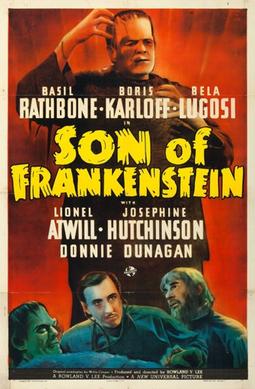
Son Of Frankenstein


The Son Of Frankenstein

Son of Frankenstein is a 1939 American horror film directed by Rowland V. Lee and starring Basil Rathbone, Boris Karloff and Bela Lugosi. The film is the third in Universal Pictures' Frankenstein series and is the follow-up to the 1935 film Bride of Frankenstein. Son of Frankenstein stars Rathbone as Baron Wolf von Frankenstein who, with his wife Elsa (Josephine Hutchinson) and son Peter (Donnie Dunagan), returns to his late father's estate. Near the castle lives Ygor (Bela Lugosi), a crazed blacksmith whose neck was broken in an unsuccessful hanging attempt. Among the castle's remains, Frankenstein discovers the remains of the Monster (Boris Karloff) and decides to try to save his family name by resurrecting the creature to prove his father was correct. He finds, however, the Monster only responds to Ygor's commands.

The film was originally announced in August 1938 after a successful theatrical reissue of Dracula and Frankenstein. Son of Frankenstein was initially announced under the title After Frankenstein. The screenplay written by Willis Cooper was initially rejected and early script drafts included only the characters that would be used in the final film. The original budget was set at $250,000 but Lee increased it to $300,000 and had a 27-day shooting schedule. Difficulties in production arose when Lee was unsatisfied with the script. Production was delayed until November 9 due to inclement weather and other problems, and filming was completed on January 5, 1939, with a final cost of $420,000. The film was released on January 13, 1939, and received positive reviews from The New York Daily News, The New York Times, Variety and the Monthly Film Bulletin. A sequel, The Ghost of Frankenstein, was released in 1942.

The Bride Of Frankenstein


The Bride Of Frankenstein

Bride of Frankenstein is a 1935 American Gothic science fiction horror film, and the first sequel to Universal Pictures' 1931 film Frankenstein. As with the first film, Bride of Frankenstein was directed by James Whale starring Boris Karloff as the Monster and Colin Clive as Dr. Frankenstein. The sequel features Elsa Lanchester in the dual role of Mary Shelley and the bride. Colin Clive reprises his role as Henry Frankenstein, and Ernest Thesiger plays the role of Doctor Septimus Pretorius. Oliver Peters Heggie plays the role of the old blind hermit.

Taking place immediately after the events of the earlier film, it is rooted in a subplot of the original Mary Shelley novel, Frankenstein; or, The Modern Prometheus (1818). Its plot follows a chastened Henry Frankenstein as he attempts to abandon his plans to create life, only to be tempted and finally blackmailed by his old mentor Dr. Pretorius, along with threats from the Monster, into constructing a bride for the Monster.

The preparation to film the sequel began shortly after the premiere of the first film, but script problems delayed the project. Principal photography began in January 1935, with creative personnel from the original returning in front of and behind the camera. Bride of Frankenstein was released to critical and popular acclaim, although it encountered difficulties with some state and national censorship boards. Since its release the film's reputation has grown, and it is now frequently considered one of the greatest sequels ever made; many fans and critics consider it to be an improvement on the original, and it has been hailed as Whale's masterpiece. In 1998, it was selected by the Library of Congress for preservation in the United States National Film Registry, having been deemed "culturally, historically or aesthetically significant".


ARCHIVIST'S NOTES:
Drs. Pretorius and Frankenstein are what Drs. West and Cain from Re-Animator could've been, given a hefty dose of psychiatric medication.

Frankenstein 1931


Frankenstein

Frankenstein is a 1931 American pre-Code science fiction gothic horror film directed by James Whale, produced by Carl Laemmle Jr., and adapted from the 1927 play Frankenstein: An Adventure in the Macabre by Peggy Webling, which in turn was based on Mary Shelley's 1818 novel Frankenstein; or, The Modern Prometheus. The Webling play was adapted by John L. Balderston, while the screenplay was written by Garrett Fort and Francis Edward Faragoh, with uncredited contributions from Robert Florey and John Russell. 

Frankenstein stars Colin Clive as Henry Frankenstein (Victor Frankenstein in the novel), an obsessed scientist who digs up corpses with his assistant in order to assemble a living being from body parts. The resulting creature, often known as Frankenstein's monster, is portrayed by Boris Karloff. The makeup for the monster was provided by Jack Pierce. Alongside Clive and Karloff, the film's cast also includes Mae Clarke, John Boles, Dwight Frye, and Edward Van Sloan. 

Produced and distributed by Universal Pictures, the film was a commercial success upon release, and was generally well received by both critics and audiences. It spawned a number of sequels and spin-offs, and has had a significant impact on popular culture: the imagery of a maniacal "mad" scientist with a hunchbacked assistant and the film's depiction of Frankenstein's monster have since become iconic. In 1991, the United States Library of Congress selected Frankenstein for preservation in the National Film Registry as being "culturally, historically, or aesthetically significant".


ARCHIVIST'S NOTES:
I do believe Colin Clive to be in the top 5 mad scientists in the history of film.


Frankenstein 1910


Frankenstein is a 1910 American short silent horror film produced by Edison Studios. It was directed by J. Searle Dawley, who also wrote the one-reeler's screenplay, broadly basing his "scenario" on Mary Shelley's 1818 novel Frankenstein; or, The Modern Prometheus. This short motion picture is generally recognized by film historians as the first screen adaptation of Shelley's work. The small cast, who are not credited in the surviving 1910 print of the film, includes Augustus Phillips as Dr. Frankenstein, Charles Ogle as Frankenstein's monster, and Mary Fuller as the doctor's fiancée.


ARCHIVIST'S NOTES:
I prefer Melies.